
Still Missing: Iran's Uranium, Ten Months Later
In June 2025 I wrote about 400 kilograms of enriched uranium that disappeared before the strikes. Here's what we've learned since, and what we still don't know.

Last June, as Israel and the United States struck Iran's nuclear facilities, I wrote a post called The Vanishing Act. The short version: satellite imagery had detected truck convoys leaving Fordow and Isfahan in the days before the strikes. The IAEA had lost access to its cameras a week earlier. Iran's stockpile of uranium enriched to 60 percent, which is approximately 400 kilograms at the time, enough to produce nine or ten nuclear weapons if further enriched, appeared to have been moved to locations unknown.
Ten months have passed. There have been two more rounds of strikes. The declared nuclear infrastructure has been hit repeatedly. Khamenei is dead. The Strait of Hormuz is blockaded. And the question I asked last June has still not been answered.
Where is the uranium?
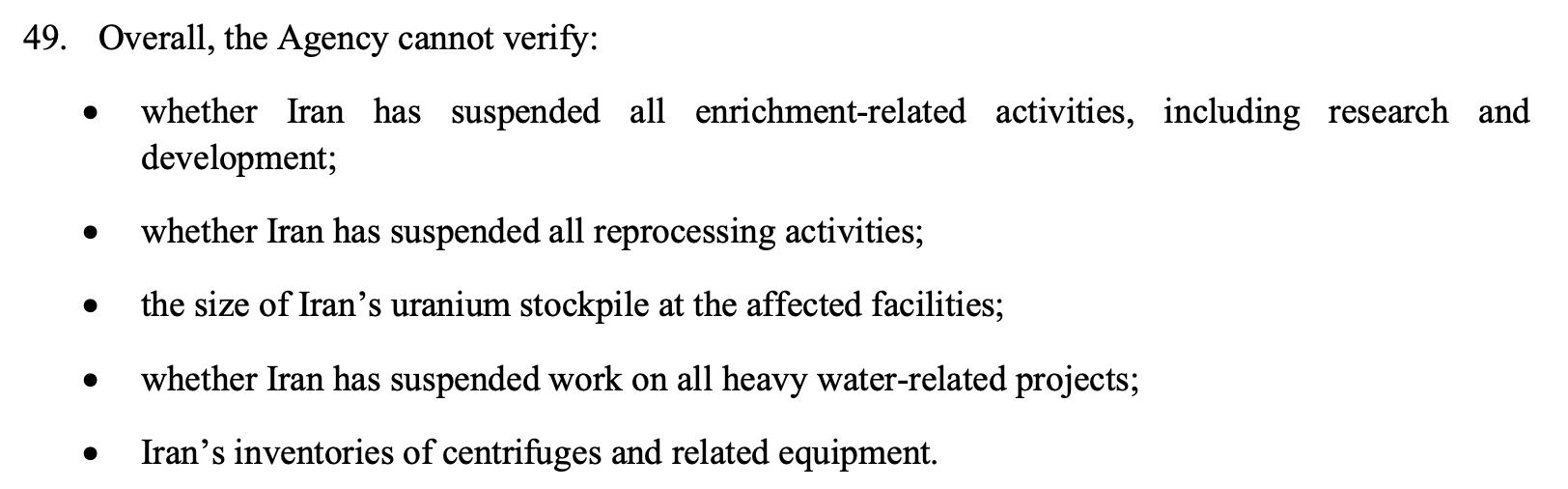
That is not a rhetorical flourish. It is the literal finding of the IAEA’s most recent report to its Board of Governors, issued February 27, 2026: the agency has not had access to verify Iran’s previously declared inventories of enriched uranium for over eight months, which it described as “long overdue according to standard safeguards practice” and “a matter of proliferation concern” (page 10):
What we know now that we didn’t know in June
A few things have clarified since The Vanishing Act. None of them are reassuring.
The Bulletin of the Atomic Scientists published a detailed satellite and technical analysis in early 2026 concluding that Iran most likely transferred its entire 60 percent U stockpile to the Isfahan underground tunnel complex on June 9, 2025, four days before Israel launched its opening strikes (note that this was reported on last year, the article was just digging deeper). A single truck carrying standard transport packages could have moved the entire 440.9 kilograms in one load. The analysis identified the vehicle in satellite imagery and worked through the geometry of the containers to show it was physically feasible.
The IAEA subsequently confirmed, in a confidential report seen by Reuters, that some of the 60 percent material had indeed been stored in that underground tunnel complex at Isfahan. It also noted that, as of early February 2026, satellite imagery showed vehicular activities near the entrances to the tunnel complex which are believed to be completely backfilled and buried with soil.
The tunnel itself appears to have survived the strikes. The entrances are sealed. The IAEA has not been inside.
The separative work argument, updated
The Center for Arms Control and Non-Proliferation published an analysis in March 2026 that put precise numbers on something I described qualitatively last June. Their calculation is worth sitting with. Also, I included more details in the appendix.
Producing Iran’s stockpile of 60 percent enriched uranium required approximately 55,330 separative work units (SWU), which is the standard measure of enrichment effort. Enriching that same stockpile the rest of the way to weapons-grade, 90 percent, would require an additional 564 SWU. That is roughly one percent of the work already done.
As Goldston puts it: 99 percent of the enrichment effort required to convert Iran's stockpile into weapons-grade uranium has already been expended. The remaining one percent could be accomplished with a single cascade of 175 IR-6 centrifuges in about 25 days. Iran has far more centrifuge capacity than that…or had, before the strikes. If the material has been split across multiple dispersed sites, each with even a partial cascade, the timelines compress further and the detection problem multiplies. If any pre-enrichment above 60 percent has already occurred in an undeclared facility (which the IAEA cannot rule out) the question is not weeks. It is days. He paints quite a picture, doesn’t he?
Destroying a centrifuge hall destroys the machines. It does not reverse the separative work those machines already performed. The material they produced is still somewhere.
This is a category error that has run through the entire war. Uranium inventories are not degraded by airstrikes. The buildings are targets. The uranium is not in the buildings. It is in cylinders, in tunnels, in locations that were deliberately moved before the strikes began and have not been monitored since.
The diplomatic signal we should probably follow up on
On March 15, 2026, Iranian Foreign Minister Abbas Araghchi told CBS News something that should have been a much bigger story. He said Iran was prepared to downblend its enriched uranium stockpile to lower enrichment levels, under IAEA supervision, as part of a negotiated settlement.
The offer matters for two reasons. First, it confirms Iran knows exactly where the material is and has maintained control of it which is relevant to the question of whether further enrichment has occurred. Second, it is precisely the kind of verifiable, material-accounting-based concession that the Center for Arms Control analysis described as “extremely valuable and well worth bargaining for.”
Downblending 440 kilograms of 60 percent uranium to reactor-grade is irreversible in any practical timeframe. It would take years of centrifuge operation to reconstitute the stockpile from a lower enrichment level. A verified downblend, with IAEA cameras and material accountancy restored, would accomplish more for nonproliferation than any number of strikes on declared facilities.
That offer was made on March 15. Within two weeks, the United States had struck Kharg Island and President Trump was threatening to destroy Iran’s power grid. The offer appears to have gone nowhere.
What this war has changed, and what it hasn’t
The February 28 strikes and their aftermath have genuinely degraded Iran’s declared military capacity. Missile launches have dropped by more than 90 percent from peak. The naval assets needed to sustain the Hormuz blockade are being ground down. The declared enrichment infrastructure Natanz, Fordow, the fuel fabrication facilities — has been severely damaged or destroyed.
What the strikes have not changed: the fissile material inventory, the institutional knowledge of the program, or the fundamental verification problem.
In fact, on the verification dimension specifically, this war has made things worse. Iran had already reduced IAEA access significantly after 2021. The June 2025 strikes prompted Iran to terminate the Cairo agreement, which was the fragile mechanism that would have allowed inspections to resume at unaffected facilities. The February 2026 IAEA report documents that Iran is now refusing access even to facilities that were never struck. A declared new underground enrichment facility at Isfahan exists, and the IAEA has not been allowed inside it.
The strikes on civilian infrastructure currently being threatened (power plants, bridges) operate at an even greater remove from the nuclear problem. The strategic theory behind them is that civilian suffering creates political pressure for capitulation. That may or may not work as a theory of regime behavior. It is not a theory of uranium accounting. It has no mechanism by which it produces an accounting of enriched uranium. It does not reopen the Isfahan tunnels to inspectors. It does not restore continuity of knowledge to a record that the IAEA has said cannot be reconstructed retroactively.
The question that was always the right one
I ended The Vanishing Act with this: “Iran’s 400 kg of 60% uranium may be out of sight, but it’s not out of play yet.”
Ten months later, the uranium is still out of sight. Whether it is still at 60 percent, or has been further enriched in an undeclared facility, is genuinely unknown. Whether the declared new underground facility at Isfahan has centrifuges installed is genuinely unknown. Whether the institutional capacity to produce more enriched uranium survives the strikes on declared facilities (in bunkers, in dispersed locations, in the heads of engineers who were not in those buildings when the bombs fell) is genuinely unknown.
These are not rhetorical or academic questions. They are the operational questions that determine whether this war ends with a more or less dangerous nuclear situation than the one it started from.
A ceasefire and a reopened strait would be real achievements. What they would not be is an answer to the question I asked last June. That question requires a different instrument entirely, such as inspectors, cameras, material accountancy, and a political framework that makes it rational for Iran to allow them back in.
Those instruments exist. They were working, imperfectly, before 2021. Building them back will be harder after this war than it would have been before it. And there is a harder truth under that: even if access were restored tomorrow, the continuity of knowledge record broken in 2021 cannot be reconstructed retroactively. The gap may already be permanent. That is the accounting the coverage keeps missing.
Appendix: Uranium enrichment in plain English
Uranium, as it comes out of the ground, is mostly useless for either reactors or weapons. Not because it lacks energy, it has plenty, but because it comes in the wrong form.
Natural uranium is a mixture of two types of uranium atoms, called isotopes. About 99.3 percent of it is a variant called U-238. The remaining 0.7 percent is U-235. Only U-235 can sustain the kind of chain reaction you need for a reactor or a bomb. The overwhelming majority of what you dig up is the wrong kind.
Enrichment is simply the process of concentrating the useful minority. You take natural uranium and you increase the percentage of U-235, separating it from the U-238, until you have a material with a higher concentration of the isotope you actually want.
Different applications need different concentrations:
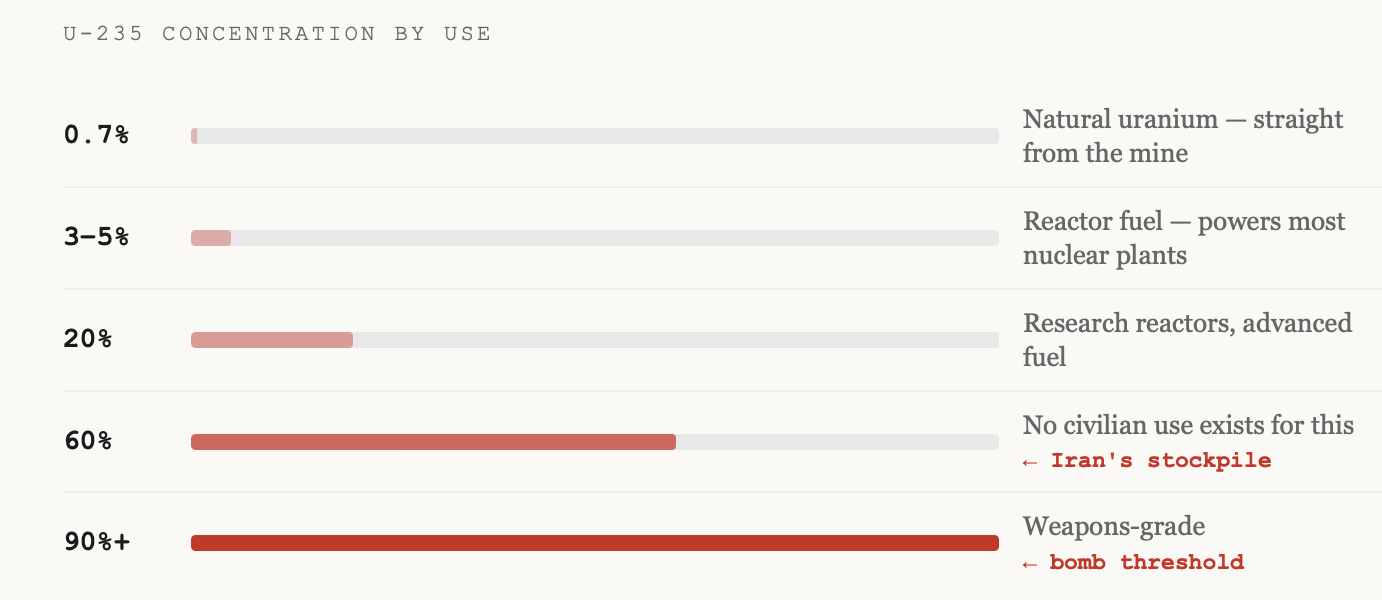
The 2015 nuclear deal (the JCPOA) allowed Iran to enrich only to 3.67 percent, the low end of reactor fuel. After the United States withdrew from that agreement in 2018, Iran began exceeding those limits. By late 2024 it had reached 60 percent, which is a level the IAEA has said explicitly has no credible civilian justification. It is not reactor fuel. It is not research material. It is a hedge.
How the machines work
The way you enrich uranium today is with centrifuges. A centrifuge is essentially a very fast-spinning cylinder, think 50,000 to 70,000 rotations per minute, into which you feed uranium in gas form. I wrote about them last summer.
When the gas spins that fast, the slightly heavier atoms drift toward the outer wall. The slightly lighter U-235 atoms stay a little more concentrated toward the center. You draw off the two streams separately. One stream is now marginally richer in U-235. The other is marginally poorer.
The key word is “marginally.” A single centrifuge produces an almost undetectable enrichment. To get anywhere useful, you chain hundreds or thousands of machines together, the output of one feeds into the next, in what is called a cascade. Each machine nudges the concentration a little higher. By the end of the cascade, you have meaningfully enriched uranium.
Why centrifuges are hard to build
The rotor has to spin at tens of thousands of RPM without tearing itself apart, which requires exotic materials and extraordinary precision manufacturing. The uranium gas is chemically aggressive and will corrode most ordinary materials on contact. The specialized components, including specific carbon fiber grades, precision bearings, vacuum systems, are tightly controlled by international export regulations, which is why the supply chain for centrifuge parts has been one of the main targets of nonproliferation enforcement for decades.
Iran has been working around those controls since the 1980s, initially using designs obtained through the Pakistani nuclear black market. Its more recent centrifuge generations are domestically developed and significantly more capable than what it started with. Thirty years of institutional knowledge cannot be destroyed by bombing a building.