
The Death Star Fallacy
MAY THE FOURTH BE WITH YOU. The Force, as ever, is with whoever does the boring industrial work.

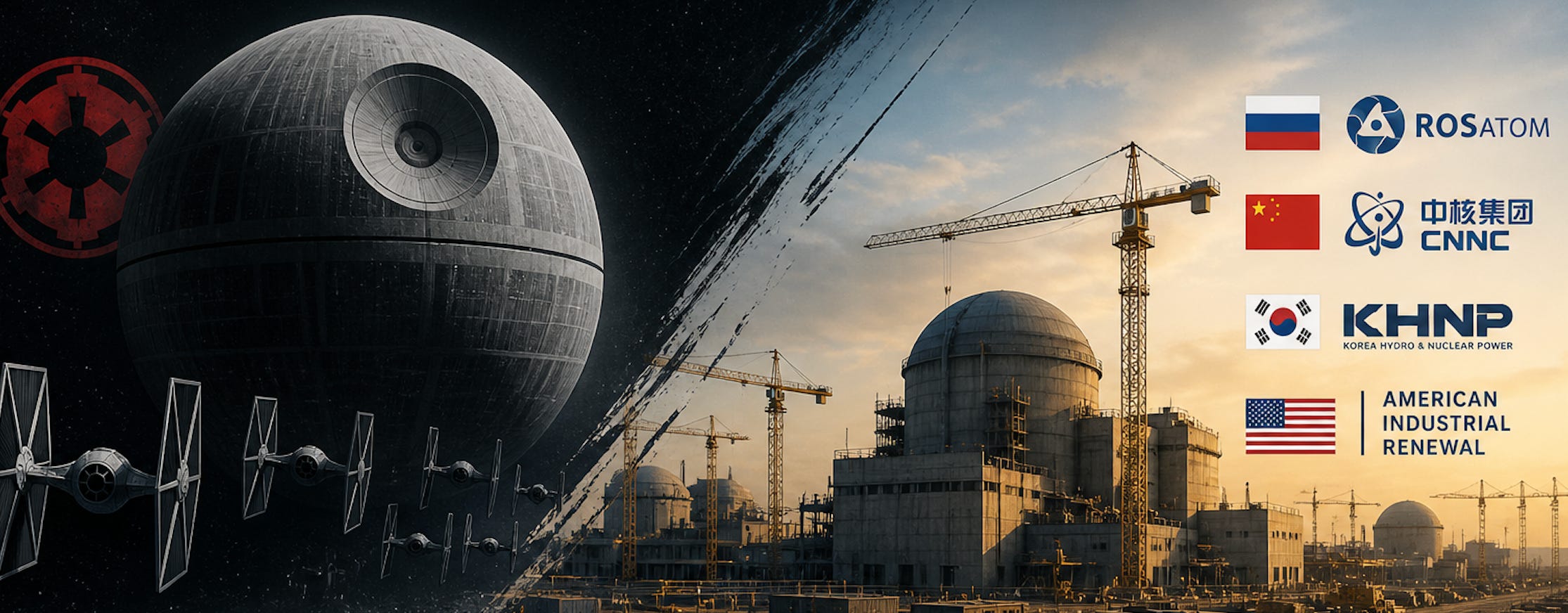
Every May the Fourth, the same image returns: a moon-sized battle station vaporizing Alderaan, then itself vaporized by a single (or was it a double?) proton torpedo down a ventilation shaft. The lesson the films want you to take away is moral; it’s about the fact that concentrated power corrupts and concentrated power is brittle. The lesson nuclear strategists took from it, when they bothered to look, was something else: the Empire built one Death Star; when the Death Star died, the Empire’s deterrent died with it.
This is not how real nuclear powers behave. The history of nuclear weapons since 1945 is a history of distributing capability across silos, submarines, bombers, and warheads, precisely so that no single decapitating strike can undo the arsenal. The triad exists because the Death Star fallacy is fatal.
And yet, on a different battlefield, one of the three great nuclear powers has, in effect, been building Death Stars. Not literal superweapons. Something closer to the inverse: a single, vertically integrated, state-financed industrial machine that controls reactor design, construction, fuel supply, and waste management end-to-end. While the United States debated regulatory reform and watched Vogtle bleed cost overruns, Russia built Rosatom. While Westinghouse went through its second bankruptcy, China approved ten new reactors a year for four consecutive years.
The Empire understood concentration. The Rebellion understood distribution. In the actual nuclear competition unfolding right now, the United States has somehow ended up with the worst of both: distributed enough to be slow, concentrated enough that a handful of suppliers can hold the entire civilian fleet hostage to a fuel cycle it does not control.
What Is Rosatom?
I’ve talked quite a bit about Rosatom in previous posts, but it always seems to be an uncomfortable subject in Washington because acknowledging the scale of the problem would require explaining why nothing was done about it for twenty years.
Rosatom is not a company in the Western sense. It is the unified Russian state nuclear apparatus (wait…also leading wind generation company in Russia), including civilian power, naval propulsion, weapons complex, fuel cycle, icebreakers, isotopes, even the Northern Sea Route, folded under a single chief executive who reports to the President. By signed export projects abroad, no Western vendor is even in the same league.
The model is what makes it formidable. A buyer country, including Turkey, Egypt, Bangladesh, and Hungary, does not negotiate with a reactor vendor and then separately with a fuel supplier and separately with a finance bank. Rosatom is all three. It designs the plant, builds the plant, finances the plant (often via a Russian sovereign loan to the buyer), supplies the fuel for the plant’s lifetime under long-term contract, and in some cases (Akkuyu in Turkey is the cleanest example) retains ownership of the plant under a build-own-operate structure, selling electricity back to the host utility.
Rosatom has the world’s largest foreign nuclear construction portfolio. By late 2025, it had signed agreements to build 22 reactors across seven countries, with active projects spanning Turkey, Egypt, Bangladesh, Hungary, China, India, and Iran — and Rosatom itself described 41 foreign units in various stages as of today. Either way you cut it, no Western vendor is in the same league.
That is not commerce. That is a multi-decade strategic dependency manufactured under the cover of a power purchase agreement. Bangladesh is the most recent demonstration: Rosatom loaded fuel into the Rooppur Unit 1 reactor on April 28, 2026, which is a $13 billion project roughly 90 percent financed by a Russian state loan, with a fuel-supply contract attached for the plant's lifetime. The country that opens that envelope is not buying a reactor. It is buying a thirty-year or longer relationship.
The numbers downstream of the reactor are at least as serious. Rosatom's fuel division, TVEL, supplies fuel to roughly 73 power reactors across 13 countries including 19 Soviet-design reactors still operating inside the European Union, every one of which depends on Russian fuel. On the enrichment side, Russia controlled an outsized share of global commercial enrichment capacity heading into the 2020s; the United States imported a substantial fraction of its enriched uranium from Russia until very recently. China spent billions of dollars on Russian enriched uranium in 2025 alone, enough additional tonnage, by industry estimates, to approach the annual fuel needs of the entire French reactor fleet.
What China Is Building At Home
If Rosatom is the export Death Star, China is building something stranger: a domestic industrial base whose scale is now beginning to bend the global numbers all by itself.
As of April 2026, China operates 62 reactors with roughly 66 GW of installed capacity, behind only the United States. It has 39 reactors under construction, for the eighteenth consecutive year, the largest active build pipeline in the world. China’s State Council approved ten new reactors in April 2025; that was the fourth consecutive year of ten-or-more approvals (yes, I’m repeating myself, but this is important). Chinese reactor construction times average about five years. Vogtle Units 3 and 4, the only new reactors completed in the United States this century, took roughly fifteen years and ended at a final cost north of thirty billion dollars.
The export side of China’s program has so far disappointed Beijing’s own ambitions. Despite the Belt and Road rhetoric, China has built only three Hualong One reactors abroad in Pakistan, financed almost entirely by Chinese loans. Argentina, the United Kingdom, and Romania walked away from announced Chinese reactor deals over financing terms, security review, or both.
But the domestic numbers are the ones that matter. China is building reactors faster than anyone else has ever built reactors, on schedule, on budget, with a domestic supply chain that achieved full localization of key components in 2024. The export business will eventually catch up, because the manufacturing base is now there. Rosatom’s market dominance has a clock on it, and that clock is set in Beijing.
Add it up: the United States operates the largest installed fleet, but the fleet is aging. China is building the future fleet at a rate that will overtake the U.S. before 2035 by every available measure. Russia owns the export market today, but its current contract pipeline is the smallest it has been in fifteen years, and the Chinese are coming.
Where Is the United States In All Of This?
The United States has not started construction on a new commercial reactor in 2026. There are zero domestic reactors under active construction. Vogtle 3 and 4 finished. Summer was canceled. NuScale’s flagship project near Idaho Falls was canceled in 2023. The “nuclear renaissance” of the late 2000s produced two new completed reactors, both in Georgia, both years late, both billions over budget.
The United States still has the world’s largest reactor fleet, but it no longer has the industrial system that built it. On the fuel side, the United States is rebuilding capacity it dismantled. The Department of Energy announced $2.7 billion in January 2026 to expand domestic uranium enrichment, split roughly evenly among American Centrifuge, General Matter, and Orano Federal Services, explicitly to reduce dependence on Russian supply. That is the right policy. It is also, by twenty years, late.
HALEU (high-assay low-enriched uranium, the fuel that essentially every advanced reactor design assumes) has effectively one commercial supplier outside Russia, and that supplier (Centrus) is producing at pilot scale. Almost every advanced reactor business plan in the United States is implicitly backstopped by an enrichment pipeline that does not yet exist at the volumes those plans require.
This is what I mean by ending up with the worst of both structural choices. The United States is not concentrated in the Imperial sense since there is no single American Rosatom that can turn a reactor deal into a thirty-year strategic relationship. But the U.S. is also not distributed in any robust sense because the suppliers that exist are few, fragile, and dependent on a handful of legacy components and on enrichment capacity rebuilt from a near-zero baseline.
It is a Rebellion fleet without the redundancy. One bankruptcy at Westinghouse, one cost overrun at Centrus, one supply disruption at Cameco, and the entire civilian nuclear posture is degraded. There is no second exhaust port because there is barely a first one.
The Korean Exception
Which brings us to the next part of the story. South Korea is presenting an interesting case study, somewhat of a hybrid.
While the United States was canceling SMRs and Westinghouse was working through bankruptcy proceedings, they built and shipped the only Generation III+ reactor program in the Western alliance system that works on time and on budget. South Korea’s Korea Electric Power Corporation and its construction arm, Korea Hydro & Nuclear Power, delivered four APR1400 reactors at Barakah, in the United Arab Emirates, a country that, in 2009, had no civilian nuclear program at all.
The numbers are worth sitting with. Contract signed December 2009. First concrete poured July 2012. Unit 1 commercial operation April 2021. Units 2 and 3 followed in 2022 and 2023. Unit 4 entered commercial operation in September 2024. Total capacity 5.6 GW. Each successive unit was delivered faster than the last as KEPCO walked the construction crews through the same design four times in a row. There is no other Western-aligned reactor program in the world with a comparable record this century.
From the World Nuclear:
In December 2009 ENEC announced that it had selected a bid from the KEPCO-led consortium1 for four APR1400 reactors, to be built at one site. The value of the contract for the construction, commissioning, and fuel loads for four units was about $20.4 billion, with a high percentage of the contract being offered under a fixed-price arrangement. The consortium also expects to earn another $20 billion by jointly operating the reactors for 60 years. In March 2010 KEPCO awarded a $5.59 billion construction contract to Hyundai and Samsung for the first plants.
The APR1400 is a 1,400 MW Generation III+ pressurized water reactor descended from the Combustion Engineering System 80+ design that Westinghouse acquired when it bought C-E in 2000. KEPCO licensed the underlying technology, evolved it through the OPR-1000, and produced the APR1400, a reactor with passive safety systems, a 60-year design life, and the dubious distinction of being the only Generation III+ design certified by both the Korean and U.S. nuclear regulators. The U.S. NRC issued design certification in 2019.
That last point matters. In October 2022, Westinghouse sued KHNP in U.S. federal court alleging that APR1400 exports required Westinghouse approval and U.S. government licensing under Part 810 export controls, because of the System 80+ ancestry. A district court dismissed the case in September 2023 on standing grounds that only the U.S. Attorney General can enforce Part 810, not a private company. International arbitration continued. For three years, the lawsuit hung over every prospective APR1400 export deal. The Czechs paused. The Poles paused. Buyers do not sign $20 billion contracts when the reactor’s intellectual-property status is being litigated in three jurisdictions.
The litigation was settled in January 2025, days after Washington and Seoul signed a memorandum of understanding on civil nuclear cooperation and exports. The terms remain confidential. The result is not: KHNP signed the Czech contract for two APR1000 units at Dukovany in June 2025, an $18.6 billion project derived from Korea’s operating reactor platform, with construction targeted to begin in 2029. The UAE is exploring follow-on units.
Stand back from this for a moment. The most successful Western reactor export program of the twenty-first century is Korean. The reactor was built by a country with no expansionist foreign policy, no sovereign-loan colonialism, no fuel-cycle leverage play (some supply chain leverage though), and a deep treaty alliance with the United States. By any rational reading of strategic interest, the APR1400 should be the cornerstone of an allied counter-Rosatom strategy. Instead, it spent three years tied up in U.S. courts.
Is the APR1400 the safest, most cost-effective, and quickest-to-build reactor available to the Western market today? On the available evidence, from Barakah’s track record, to the NRC certification, to the Czech contract pricing, yes, with one honest caveat. The Korean nuclear regulatory environment is less adversarial than the U.S. NRC, and “on time and on budget” in the UAE benefited from regulatory conditions that would not transfer cleanly to a Western European or U.S. siting process. But that caveat applies to every reactor built outside the U.S., and it does not change the underlying reality. Korea is the only Western-aligned nuclear vendor with a recent multi-unit Gen III+ export project completed and operating outside Russia and China. That is not a marketing claim. That is a fact.
The Koreans are stealthy. They do not run press tours. KEPCO does not publish triumphalist five-year plans. KHNP's CEO is not on cable news. They built four reactors in a desert, settled their litigation with the patent holder, signed a contract in central Europe, and went back to building. That is what an industrial program looks like.
What the Death Star Got Right
To be fair to the Empire…frankly, a sentence I did not expect to write today…Star Wars did get one thing right, and it is the thing the United States has internalized least.
The Death Star was designed to project power. It was an instrument of signaling. Its existence was supposed to deter rebellion before any shot was fired. That is, in fact, the central logic of nuclear deterrence. Capability you cannot demonstrate is capability your adversary discounts.
Rosatom understands signaling. Every reactor it sells in Africa, every fuel contract it locks down in Eastern Europe, every IAEA-blessed safeguards arrangement it shapes from the inside is a demonstration that the Russian state can deliver complex civilian nuclear infrastructure where Western suppliers cannot or will not. That is power projection. The audience is not just the buyer; the audience is every other prospective buyer watching the deal close.
China understands signaling too. Ten reactors a year, on schedule, on cost, with full domestic supply, is a signal directed at exactly the audience that matters: countries deciding which civilian nuclear partner to trust over a sixty-year horizon.
Korea understands signaling without performing it with Barakah being the demonstration, and the demonstration speaks for itself.
The United States has not signaled at this register since the late 1970s. The signal it has been sending instead through canceled projects, regulatory unpredictability, bankrupt vendors, a fuel cycle held together by emergency federal funding, and three years of suing its own ally is that American civilian nuclear is not a serious option for any country making a multi-decade commitment.
The Distributed Future
The right ending here is not pessimism. The right ending is precision about what would have to change. I talk to a lot of companies, some with more mature designs and aspirations than others. A serious U.S. response is not “build a Rosatom.” Vertical state integration is not available to the American political economy and probably should not be. The serious response is to rebuild distributed redundancy with multiple licensed reactor designs, multiple enrichment vendors, multiple fuel fabricators, multiple finance vehicles fast enough to matter on the timeline that is reasonable. And, candidly, to stop pretending the alliance system does not contain a working nuclear vendor already.
That requires four things, none of which is glamorous and none of which fits in a press release.
First, finished enrichment capacity at commercial scale, on a guaranteed offtake basis, before 2030. The DOE’s $2.7 billion is a down payment, not a solution. The full-scale capacity needs to be operating, not announced. Better yet, stop designing systems relying on non-existent fuel, or at least diversify.
Second, a regulatory pathway that does not punish the second customer for a design more than the first. The current system makes every deployment an exquisite snowflake, which is the structural opposite of what makes Chinese construction cheap and Rosatom exports replicable.
Third, financing structures that absorb first-of-a-kind risk without requiring every project to relitigate the last forty years of cost-overrun history. If the United States cannot match Rosatom’s sovereign-loan-and-build-own-operate model (and it cannot), it has to find some other way to give buyer countries a credible thirty-year proposition.
Fourth, an honest treatment of the alliance partner that already builds working reactors. The January 2025 settlement was the precondition for KHNP to export with U.S. blessing. The follow-on question is whether the United States is prepared to actively support APR1400 deployments in third markets, or treat them as competition for a domestic Westinghouse pipeline that will not exist for another decade.
None of that is a Death Star. None of it is a single dramatic project that can be unveiled at a press conference. That is the point. Distributed deterrence — civilian or military — is built from many small, durable, replaceable pieces, none of which is individually impressive and all of which together are very hard to defeat.
The Force, as ever, is with whoever does the boring industrial work.
Dr. Erickson's post commemorates the very important day for Star Warr community and makes an excellent connection to and with contemporary developments in nuclear. As always, Dr. Erickson analysis is thought-provoking read for all of us in nuclear community. The cultural connection makes it even more interesting and important. We have 130+ civilian commercial vendors in the U.S. alone which makes the nuclear industry and nuclear energy domain very active endeavors to pursue. May the Fourth be with you!